
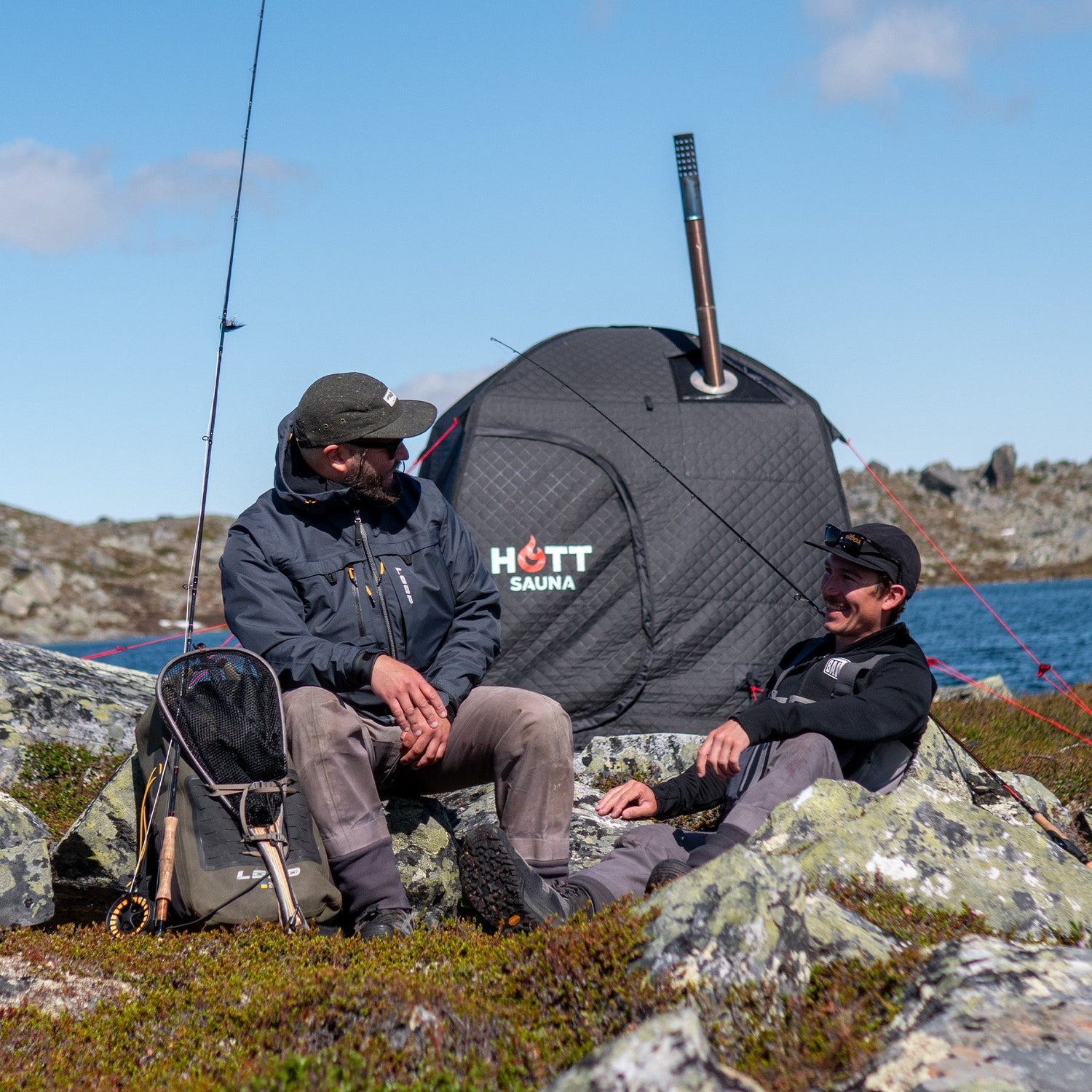
Short answer: Sauna tents fall into three main types: pop-up tents that can be set up in minutes, compact tents with tent poles that are easier to carry, and larger, multi-room tents that take longer to set up. The right type for you depends on how many people you are, how far you’ll carry the tent, and whether you’ll use the sauna in winter. That’s when insulated fabric makes a big difference.
At Baitbox, we’ve been testing sauna tents for many years, and HOTT Sauna is our own sauna tent brand. Here, we explain the differences between the various types so you can choose the right one from the start.
1. Pop-up sauna tents: quickest to set up
A pop-up tent has a built-in frame that unfolds much like an ice-fishing tent. Pull out the corners, the tent pops up, and you can secure it in place right away. This makes a pop-up model the most convenient choice when the sauna needs to be put up and taken down often, for example at home in the garden, at a cabin, or at a campsite.
- Advantages: sets up in minutes, spacious, and easy for one person to pitch.
- Drawbacks: the frame makes the tent heavier and bulkier when packed, so it’s better suited to a car than a backpack.
Example: HOTT Flamman is a pop-up sauna tent for 4–8 people. It pops up in about 5 minutes, has 7 panoramic windows, and measures 280 × 290 × 205 cm. The tent weighs about 22 kg and packs into a carry bag with backpack straps.

2. Compact sauna tents with tent poles: the easiest to carry
This type is set up by threading tent poles through sleeves in the fabric. Assembly takes a few minutes longer than for a pop-up tent, but in return, the tent is lighter and takes up less space when packed. It’s the type for anyone who wants to carry their sauna to a fishing spot, a mountain lake, or an island that can’t be reached by car.
- Advantages: lightweight, compact when packed, and less space to heat, so it warms up faster.
- Drawbacks: fewer people can fit inside and setup takes a little longer.
Example: HOTT Gnistan fits 2–5 people and can be set up with tent poles in about 10 minutes. The tent weighs about 11 kg, measures 210 × 210 × 190 cm, and has 2 panoramic windows. Thanks to its smaller volume, it heats up in about 10–15 minutes.

Insulated or uninsulated fabric?
Regardless of the design, the fabric is the most important difference between sauna tents. Simple, uninsulated fabric is lightweight but lets the heat escape as soon as the fire dies down. Insulated, multilayer fabric retains heat and lets you enjoy a sauna even when it’s really cold outside.
Both HOTT models have three-layer Oxford fabric that is treated with flame retardants and completely free of PFAS, and they have been tested in temperatures as low as −30 °C.
What should be included when you buy a sauna tent?
The tent is only half the sauna. Check that the package includes:
- A wood-burning stove with space for sauna stones. A built-in stone compartment transfers heat to the stones more effectively and creates authentic löyly.
- Chimney pipe with a spark arrestor to reduce the risk of sparks landing on the tent fabric.
- Carrying bags for both the tent and stove, preferably with backpack straps so you can easily take your sauna with you.
- Accessories such as sauna stones, a bucket and ladle, a thermometer, and a stove floor protector.
HOTT sells both models in three package tiers. BASE includes the tent, stove, chimney pipe, and carrying bags. PRO adds sauna stones, a sauna bucket and ladle, a thermometer, and more accessories. MAX is the complete package, including an all-weather cover and water tank.
How to choose the right type of sauna tent
| Your situation | Best suited for |
|---|---|
| 2–5 people, the sauna needs to be carried over longer distances | Compact tent with tent poles, such as Gnistan |
| 4–8 people, garden, cabin, or transport by car | Pop-up tents, such as Flamman |
| Set up in the same place for a long time, with a separate changing room | Larger tents with multiple rooms |
| Winter swimming and sauna in sub-zero temperatures | Multi-layer insulated fabric, regardless of size |
Frequently asked questions about sauna tents
How many people fit in a sauna tent?
It depends on the model. Compact tents often fit 2–5 people, while larger pop-up tents fit 4–8 people. HOTT Gnistan is designed for 2–5 people, and Flamman for 4–8.
How hot does a sauna tent get?
A sauna tent with a wood-burning stove reaches normal sauna temperatures. HOTT tents reach 75–80 °C in about 10–15 minutes and can easily exceed 100 °C. Learn more in Is a sauna tent a real sauna?
Do you need a building permit for a sauna tent?
No. A sauna tent is a temporary structure and does not require a building permit, whether you set it up in your garden, at your cabin, or out in nature. However, always check for any fire bans where you plan to light a fire.
Can you use a sauna tent in winter?
Yes, if the fabric is insulated. Three-layer fabric retains heat even in extreme cold, and a sauna tent pairs perfectly with winter swimming in an ice hole or an open lake.
How much does a sauna tent cost?
At HOTT, complete packages with a tent, stove, chimney, and carrying bags start at around SEK 17,000. A custom-built sauna often costs SEK 50,000–150,000. See the comparison in Build a sauna or get a sauna tent?
Want to learn more? Read our comprehensive guide to sauna tents with full specifications, or see all sauna tents at HOTT Sauna.


Leave a comment
This site is protected by hCaptcha and the hCaptcha Privacy Policy and Terms of Service apply.